


India’s Proximity Archives
South Asia
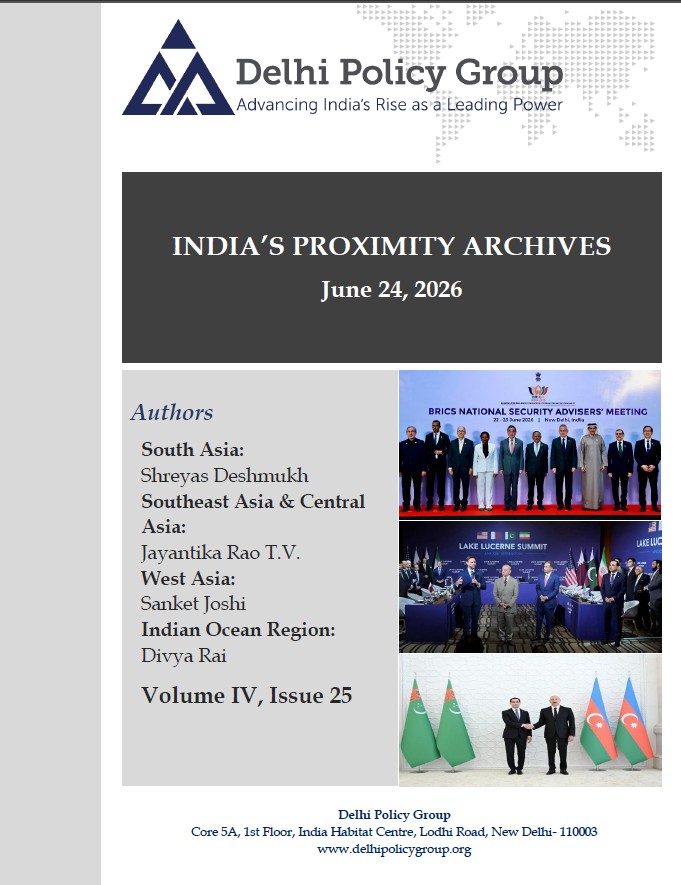
BRICS National Security Advisers convened in New Delhi from June 22-23. The meeting, chaired by India’s National Security Advisor Ajit Doval, was attended by Chinese Foreign Minister Wang Yi, Russian Security Council Secretary Sergey Shoigu, Iran’s Deputy Secretary of the Supreme National Security Council Ghadir Nezamipour, and officials from other BRICS nations. Themes of the discussions were ‘Non-traditional security challenges confronting the world today,’ which includes the swift evolution of national security threats and the role of new technologies in emerging risks. The discussion also included cyber security, digital vulnerabilities, and AI-driven threats. The war in West Asia was also one of the main topics of the discussion, as reported by Chinese and Iranian press releases.
Southeast Asia
The ASEAN–Russia Commemorative Summit was held in Kazan on June 17–18, marking 35 years of relations and 30 years of dialogue partnership. Leaders from 10 of ASEAN’s 11 member states and Russian President Vladimir Putin pledged to expand trade, energy, and security cooperation. The summit’s agenda included exchanging views on global and regional issues, reviewing efforts to develop Russia-ASEAN ties and discussing areas and tasks for future cooperation. During the summit, the two sides adopted a number of outcome documents, including the Kazan Declaration 2026, which pledged to expand cooperation across a host of different fronts, based on a “common aspiration” for “a just multipolar world as guided by international law and the principles of the U.N. Charter.” The two sides also adopted the ASEAN-Russia Comprehensive Plan of Action 2026-2030, which will serve as a “guiding document” for future engagement between the regional bloc and Moscow.
Read More…
West Asia
A high-level dialogue between the U.S. and Iran was mediated by Pakistan and Qatar in Switzerland on June 21-22. Pakistan's Prime Minister Shehbaz Sharif announced that Washington and Tehran had “agreed on a roadmap toward an agreement within 60 days” and the establishment of a high-level political oversight committee. Four technical working groups began discussions, on sanctions termination, nuclear affairs, Iran reconstruction and economic development, monitoring and implementation. According to reports, U.S. Vice President J.D. Vance claimed that Iran had agreed to allow IAEA inspectors back into the country for nuclear site inspections. However, the Iranian Foreign Ministry rejected such reports, stating that there are no plans for IAEA inspectors to visit Iran's nuclear sites.
Central Asia
In a short, but highly significant visit, the President of Turkmenistan Serdar Berdimuhamedov was received by Azerbaijan President Ilham Aliyev in Baku on June 22. Following a closed door, one-on-one meeting, a ceremony for the exchange of documents signed was held where the two leaders exchanged a variety of agreements such as the joint statement, various agreements for mutual trade, and cooperation in healthcare. The joint statement highlighted an agreement to streamline “technical specifications” concerning the movement of goods and vehicles between the two countries, and another to harmonize “customs statistics of mutual trade.” Additional agreements covered cooperation in such spheres as energy, industry, agriculture, banking and labour migration. The two leaders also issued instructions to empower an intergovernmental commission, which is now scheduled to meet in July in Ashgabat, to implement the Baku agreements.
Indian Ocean Region
Prime Minister Shri Narendra Modi commissioned three frontline platforms – INS Dunagiri, an advanced stealth frigate; INS Sanshodhak, a survey vessel (large); and INS Agray, an anti-submarine warfare shallow watercraft – into the Indian Navy in Kolkata, West Bengal, on June 21, 2026. The three ships represent three different operational pillars of the Indian Navy — surface warfare, maritime survey and anti-submarine warfare. All three vessels were designed by the Navy's Warship Design Bureau and built by Garden Reach Shipbuilders and Engineers (GRSE), Kolkata. Two more Project 17A frigates, INS Mahendragiri and INS Vindhyagiri, will be commissioned in July. The three platforms demonstrate the growing maturity of India’s shipbuilding ecosystem, with indigenous content exceeding 75 per cent. Their construction involved extensive participation by Indian industry, including more than 200 MSMEs, and generated substantial direct and indirect employment.