


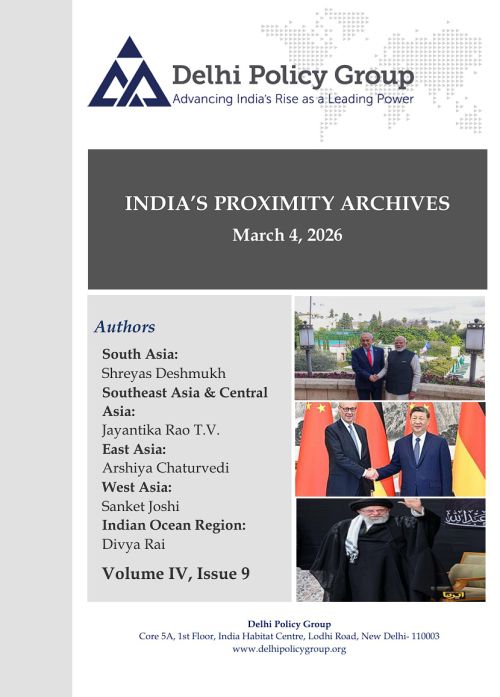
India’s Proximity Archives
South Asia
Nepal will hold its general election on March 5 to choose a new government. This election is the first since the CPN (UML) leader KP Sharma Oli led government was overthrown by youth-led anti-corruption demonstrations in September 2025. Nearly 19 million people are expected to vote for 275 members of parliament, from a pool of over 3,400 candidates. The leading candidates for the prime ministerial position include Balendra Shah of the Rastriya Swatantra Party (RSP); Gagan Thapa of the Nepali Congress; KP Sharma Oli of the Communist Party of Nepal (UML); and Pushpa Kamal Dahal of the Nepali Communist Party (NCP). Reports hint that Balendra Shah is the frontrunner in anti-system sentiment, even though reliable opinion polls are absent. The election campaign focuses on issues such as government mismanagement, corruption, joblessness, and the emigration of young people
Southeast Asia
On March 3, Philippine President Ferdinand Marcos Jr. and South Korean President Lee Jae Myung agreed to strengthen bilateral economic cooperation in areas including artificial intelligence (AI), the defence industry, nuclear energy and critical minerals during their summit talks in Manila. The two countries inked a total of 10 memorandums and contracts. In the defence sector, they agreed to institute measures such as loosening procurement conditions and expanding the range of South Korean companies eligible for no-bid contracts. The leaders also exchanged views on international affairs, including developments in the surrounding region and the Middle East. Marcos said both countries recognise uncertainties in the region, and they agreed to support the rules-based international order, including in the maritime domain.
East Asia
On February 25, German Chancellor Friedrich Merz, during his state visit to China, met with Chinese President Xi Jinping in Beijing. Highlighting the economic strengths of China and Germany, Xi called for advancing the bilateral relationship, which would serve not only their respective national interests but also Europe and the world at large. To this end, he made three propositions, including upholding mutual respect, trust, and open cooperation; facilitating the two-way flow of talent, knowledge, and technology, including collaboration on AI and other emerging tech; and strengthening cultural and people-to-people exchanges. Xi also urged the two countries to uphold the system and promote multilateralism. Chancellor Merz, speaking positively about this bilateral relationship, expressed the German government’s intention to work with China to strengthen this further.
West Asia
On February 28, 2026, the U.S. and Israel launched a major military offensive against Iran, killing its Supreme Leader, Ayatollah Seyyed Ali Khamenei and senior military leaders of the Islamic Revolutionary Guard Corps (IRGC). U.S. presidentialenvoy Steve Witkoff said that the Iranian officials continued to insist on their "inalienable right" to enrich nuclear fuel, leading Washington to initiate military action. President Trump asserted that Ali Khamenei was "one of the most evil persons in history" and his death was justice for the people killed or mutilated by the Iranian regime's "bloodthirsty thugs". Reacting sharply, Iran launched a barrage of missile and drone attacks targeting Israeli cities and U.S. military bases in Gulf countries.
Central Asia
On March 3, Kazakhstan’s Deputy Foreign Minister Alibek Bakayev said Kazakhstan does not take sides in the escalating Middle East conflict and calls for disputes to be resolved exclusively through diplomatic means. “Kazakhstan advocates resolving any military conflict at the negotiating table, in accordance with international law and the UN Charter,” Bakayev said, stressing that Kazakhstan’s position of non-interference in the affairs of other states remains unchanged. He emphasised that “We are not taking sides – neither with Iran nor with the countries that were attacked. Our goal is to prevent such conflicts, and if they arise, they must be settled through diplomacy.”
Indian Ocean Region
Operation Epic Fury, launched by U.S. Central Command, targeted Iran's Navy and IRGC Navy assets, with U.S. Navy vessels initiating widespread strikes on Persian Gulf naval bases like Bandar Abbas and Konarak. Destruction of the Iranian Navy and the Iranian Revolutionary Guard Corps Navy is a priority of the ongoing Operation Epic Fury. Key targets within the first 48 hours included anti-ship missile sites, frigates (Bayandor, Alvand, and Jamaran classes), the drone carrier IRIS Shahid Bagheri (a converted containership), the forward basing ship IRIS Makran, midget submarines, and Kilo-class boats, resulting in sunken vessels, fires, and destroyed infrastructure as confirmed by satellite imagery from Vantor and Planet. Satellite photos also show the Iranian forward basing ship IRIS Makran was struck while at the pier at Bandar Abbas. CENTCOM reports the complete denial of Iran's 11 warships in the Gulf of Oman, refuting Iranian claims of hitting USS Abraham Lincoln, while U.S. forces like Hellfire-armed Seahawks and littoral combat ships counter asymmetric threats such as small boats, drones, mines, and swarm tactics. Despite the devastation, IRGC commanders vowed to enforce a Strait of Hormuz closure, threatening global oil and gas flows.