


India’s Proximity Archives
South Asia
Kassym-Jomart Tokayev, the President of Kazakhstan, and Shavkat Mirziyoyev, the President of Uzbekistan, visited Pakistan on February 3-4 and February 5-6, respectively. The visit of the President of Kazakhstan to Pakistan, the first in 23 years, has led to the mutual decision to enhance bilateral ties to the level of a Strategic Partnership. Pakistan upgraded its bilateral relationship with Uzbekistan to a comprehensive strategic partnership. The Pakistan-Uzbekistan joint declaration affirms their commitment to develop and strengthen cooperation with the objective of supporting each other’s sovereignty. The primary focus of discussions during these visits centred on transit trade, security matters and the evolving situation in Afghanistan.
Southeast Asia
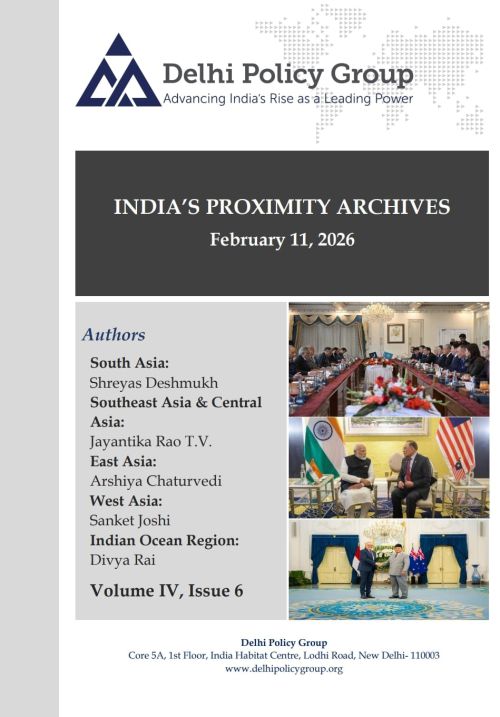
On February 8, India and Malaysia announced new initiatives to deepen cooperation in defence, security, semiconductors, and trade following wide-ranging talks between Prime Minister Narendra Modi and his Malaysian counterpart Anwar Ibrahim. Modi described the relationship as “special,” highlighting commitments to strengthen counter-terrorism, intelligence sharing, and maritime security, while broadening defence collaboration. He also emphasized that with support from partners like Malaysia, India aims to expand its engagement with ASEAN, positioning the partnership as both bilateral and regionally strategic.
East Asia
Sanae Takaichi won a decisive victory in the February 8th snap election, winning 316 out of 465 seats in Japan’s Lower House. This is the first time since the establishment of Japan’s parliament in 1947that a single party has secured two-thirds of the chamber. The results also triggered a positive market response, with Japan’s stock market reaching a record high. Takaichi's calculated bet on a snap election has proven successful. This majority was necessary to effectively advance her ambitious and assertive fiscal and security policy.
West Asia
On February 6, the U.S. and Iran resumed their indirect nuclear dialogue in Muscat, Oman. President Trump stated that the two sides held “very good talks” and that Iran was eager to reach a deal, but it remains to be seen what that deal looks like. Iran’s Foreign Minister Seyed Abbas Araghchi called upon the U.S. to honour its commitments and pursue dialogue based on equality, mutual respect and mutual interest. He reiterated that U.S.-Iran dialogue should only focus on the nuclear issue, and Iran's ballistic missile program was not negotiable. Iran’s Atomic Energy Agency Chief Mohammad Eslami urged the U.S. to lift all sanctions against Tehran to dilute its 60 percent enriched Uranium.
Central Asia
On February 9, U.S. Vice President JD Vance arrived in Armenia— a country that no sitting U.S. Vice President or President has visited before — as the Trump administration offered economic opportunities while working to advance a U.S.-brokered deal aimed at ending a decades-long conflict with Azerbaijan. Vance and Armenian Prime Minister Nikol Pashinyan signed an agreement to push forward negotiations on a civil nuclear energy deal, and Vance said the U.S. was ready to export advanced computer chips and surveillance drones to Armenia, and invest in the country’s infrastructure. Pashinyan expressed his gratitude toward President Donald Trump and Vance, noting that he had accepted an invitation to participate in the first meeting of Trump’s Board of Peace on Feb. 19 in Washington.
Indian Ocean Region
Indonesia and Australia signed the Treaty on Common Security (also called the Treaty of Jakarta 2026) on February 6, 2026, in Jakarta. The pact builds on the announcement during Indonesian President Prabowo Subianto's November 2025 visit to Australia. The signing of the treaty follows the conclusion of negotiations announced in late 2025 and builds on existing defence cooperation frameworks, including arrangements for joint exercises, defence education, and capacity-building initiatives. Both governments indicated that the agreement would further strengthen collaboration between their defence institutions and support continued engagement between armed forces. While the agreement does not constitute a formal military alliance or mutual defence obligation, it institutionalises security cooperation that has expanded steadily in recent years. Leaders emphasised deepened trust under their Comprehensive Strategic Partnership, building on 30 years of defence ties.