


India’s Proximity Archives
South Asia
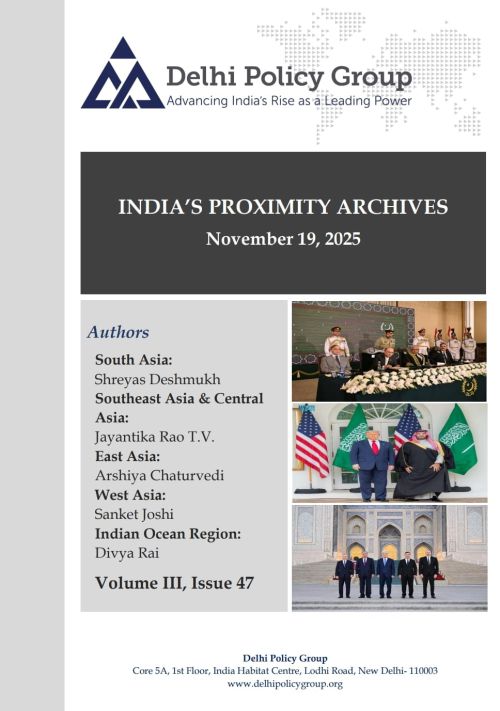
On November 13, President Asif Ali Zardari ratified the 27th Constitutional Amendment Bill subsequent to its passage by the Senate and National Assembly of Pakistan. Key aspects of the bill are setting up a Federal Constitutional Court (FCC); granting permanent immunity to the President; Army chief to be recognised as Chief of Defence Forces; office of CJCSC to be abolished; establishing a National Strategic Command; and lifelong constitutional protection to be provided to 5-star rank officers. The legislation also empowers the Prime Minister and the President to appoint and transfer judges. The FCC was formally established on November 14th, after the chief justice and four judges were sworn in. Two Supreme Court justices resigned, describing the legislation as an infringement upon the Constitution and the judiciary’s autonomy. The Tehreek-i-Tahafuz-i-Ayin-i-Pakistan (TTAP) opposition alliance declared a nationwide protest against the 27th Amendment.
Southeast Asia
On November 17, Indonesia and Japan, at the 3rd two-plus-two Foreign and Defence Ministers’ meeting in Tokyo, agreed to strengthen their security cooperation, mainly through transfers of defence equipment. The ministers also confirmed that they will promote joint drills between Japan’s Self-Defence Forces and the Indonesian military, as well as exchanges between defence officials of the nations. Prior to the meeting, Indonesian Defence Minister Sjafrie Sjamsoeddin and Japan’s Defence Minister Shinjiro Koizumi travelled to the Yokosuka naval base, where they inspected Maritime Self-Defence Force vessels, including the Mogami-class Kumano frigate and a Murasame destroyer, along with a Taigei-class submarine.
East Asia
On November 14, the US and South Korea revealed details of a new trade agreement, which includes lowering of import tariffs on South Korean goods from 25 per cent to 15 per cent, and significant South Korean investments of USD 150 billion and USD 200 billion in America’s shipbuilding and industrial sectors, respectively. Moreover, the US has also approved South Korea building nuclear-powered submarines and pledged to work closely with Seoul to find avenues to source fuel (uranium enrichment). North Korea’s state news agency KCNA, while criticising this deal, called out the US and South Korea for showing their true colours of confrontational will and hostility against the DPRK. It alleges that Seoul is pushing forward its long-standing desire to possess nuclear weapons, which will trigger a regional domino phenomenon, fuelling a nuclear arms race.
West Asia
On November 17, the United Nations Security Council adopted a US-sponsored resolution endorsing President Trump's Gaza peace plan and authorising an International Stabilisation Force to be deployed in Gaza. Thirteen UNSC member-states voted in favour of the resolution, none opposed it, while China and Russia abstained. US Ambassador to the UN, Mike Waltz, described the adoption of the Gaza peace plan as “charting a new course for the Middle East”, stressing that the UNSC resolution provides troop contributing countries with a framework to move forward with the International Stabilisation Force and global financial institutions a path to channel investment. This would help the international community dismantle Hamas and support Gaza’s reconstruction and development.
Central Asia
On November 15-16, Central Asian leaders met in Tashkent for the seventh Consultative Meeting of Heads of State, emphasising stronger political dialogue, economic integration, and collective security. The Tashkent meeting focused on strengthening institutional foundations of regional cooperation, with proposals to transform the current consultative system into a long-term strategic platform called the “Community of Central Asia,” complete with a rotating Secretariat, a Council of Elders and enhanced roles for national coordinators. During the meeting, Central Asian leaders unanimously approved Azerbaijan's accession to their consultative format as a full member. In his opening remarks, Uzbekistan’s President Shavkat Mirziyoyev proposed turning the loose consultative mechanism into a formal regional body under the working title, the “Community of Central Asia.” In the security domain, the leaders endorsed a Concept of Regional Security and Stability, calling for coordinated efforts to counter terrorism, extremism, cyber threats, and transnational crime. They also discussed mechanisms to monitor vulnerabilities in water and energy infrastructure.
Indian Ocean Region
Admiral Dinesh K Tripathi embarked on an official visit to the United States from November 12 to November 17 to further enhance the longstanding maritime partnership between the Indian Navy and the United States Navy. Admiral Tripathi held a series of high-level discussions with Admiral Samuel J Paparo, Commander of the US Indo-Pacific Command, and senior officials of the US Navy. They held discussions to review the key pillars of the India-US defence cooperation, including strengthening maritime security and maritime cooperation, and enhancing interoperability.