


Indo Pacific Monitor
Relations between Japan and China frayed as the latter sought to undermine Japan’s Prime Minister Sanae Takaichi and pressurise her into retracting her remark that China’s use of military force in a Taiwan contingency could constitute a survival threatening situation for Japan. US President Donald Trump reportedly advised Takaichi to temper her comments on the Taiwan issue to avoid endangering his deal making with President Xi Jinping.
Indonesia’s President Prabowo Subianto made a state visit to Australia, announcing conclusion of negotiations for a new bilateral treaty committing the two countries to consult with each other at leader and ministerial levels regularly on matters of security, as well as if either country feels threatened. The treaty is expected to be signed in January 2026.
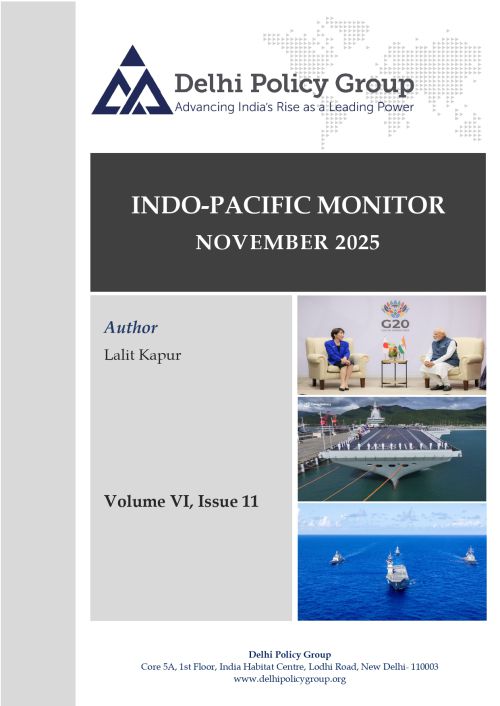
China commissioned its third and largest aircraft carrier, Fujian, into service on November 05. The carrier is equipped with the EMALS aircraft launch system, enabling it to operate heavier aircraft. The first of China’s new generation of Amphibious Assault Ships, Sichuan, sailed for a sea trial from November 14-16. The two ships represent the quantum leap taking place in China’s naval technology.
Saudi crown prince Mohammad Bin Salman visited the US, renewing Saudi Arabia’s strategic partnership with the US that had suffered under the Biden Administration. The visit resulted in the designation of Saudi Arabia as a major non-NATO ally, announcement of a substantial US arms sales package, and a Saudi commitment to invest nearly $ 1 trillion in the US.
The Thailand-Cambodia ceasefire deal announced by President Trump last month was suspended on November 10 after four Thai soldiers were injured by blasts attributed to Cambodian landmines.
The US formally announced on November 13 approval for South Korea to build nuclear attack submarines at the Hanwha Shipyard in Philadelphia.
The Prime Ministers of Australia, Canada and India announced on November 22 that their countries had entered into a trilateral technology and innovation partnership.
The 3rd Indonesia-Japan Foreign and Defence Ministers 2+2 Meeting took place in Tokyo on November 17, over four years after the second meeting. The ministers agreed to step up cooperation. Japan has proposed building Mogami-class frigates for Indonesia.
The India-Indonesia Defence Ministers’ Dialogue took place in New Delhi on November 27. Both sides agreed to enhance defence cooperation, including in defence industry and technology, military-to-military engagements, maritime security, submarine capability and in multilateral forums.
The Prime Ministers of Japan and Fiji held a bilateral summit in Tokyo on November 13 and decided to establish a comprehensive partnership based on unity and trust.
Japan’s Ministry of Defence requested a budget of around 8.8 trillion Yen (about $ 60.2 billion) for FY 2026, reflecting a continued thrust to enhance military spending to 2% of the GDP amid growing regional security challenges.
Australia achieved another milestone in the AUKUS programme when it established the Naval Nuclear Power Safety Regulator on November 01.
Exercise Malabar 2025 took place off Guam from November 11-18. India was represented by INS Sahyadri. The ship also participated in Exercise AUSINDEX 2025 thereafter.
IRGC forces seized the Cyprus registered tanker MT Talara carrying petrochemicals from Sharjah to Singapore in the Straits of Hormuz on November 14. The tanker was allowed to continue her voyage on November 19.
The Indian Navy commissioned two ships during the month, survey vessel INS Ikshak and the first ASW Shallow Water Craft INS Mahe.
These and other developments are covered in this Indo-Pacific Monitor Vol. VI, Issue 11. To read about them, please see the PDF attachedAs always, your comments and feedback are welcome.