


India Strategic Review
The ISR features an assessment of key developments, trends, and policies pertaining to India’s immediate and continental neighbourhood and is authored by Lt. Gen. Deependra Singh Hooda (Retd.), Distinguished Fellow for Military Strategy.
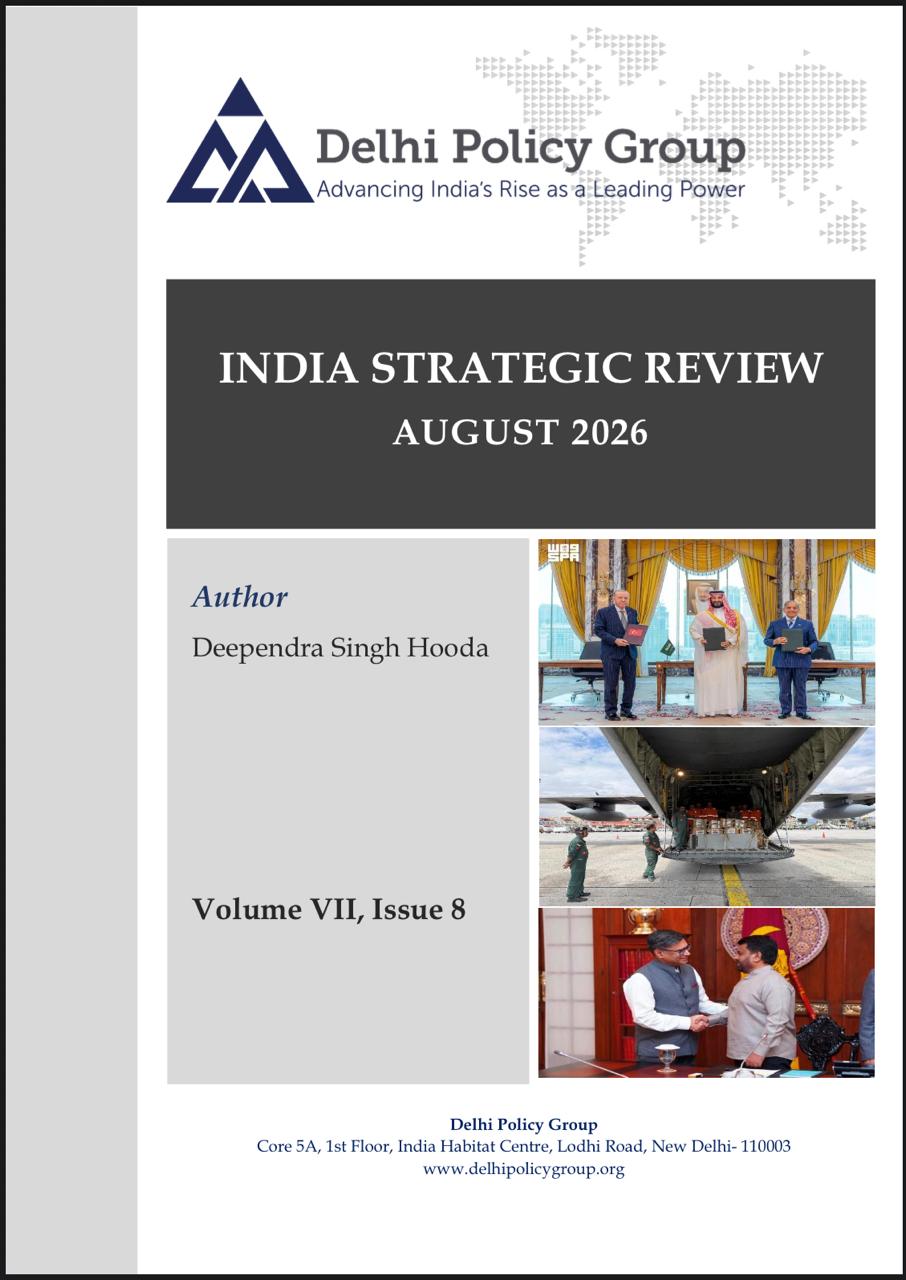
On August 7, Saudi Arabia, Türkiye and Pakistan signed the Makkah Joint Defence Agreement, under which an attack on one is treated as an attack on all. The three countries are moving to institutionalise the arrangement through political and military mechanisms, joint exercises and defence-industrial cooperation. Pakistan also continued its mediation efforts in the US-Iran conflict, although prospects for a breakthrough remained uncertain after the June agreement unravelled and there were renewed hostilities.
Pakistan’s internal security situation remains under severe pressure. July was the deadliest month of 2026, with 606 fatalities linked to militant violence and counter-terrorism operations, and the violence continued into August in Khyber Pakhtunkhwa and Balochistan. Military operations have inflicted substantial casualties on militants, but Islamabad is yet to articulate a credible political strategy for either Baloch grievances or governance in the tribal districts.
The elections to the Legislative Assembly of Pakistan-occupied Kashmir concluded during August amid violence, boycott calls and allegations of rigging. The PML-N has returned to power after a decade, but the underlying local grievances over political representation, resource control and Islamabad's institutional control continue to simmer.
August marked five years of Taliban rule in Afghanistan. The government has consolidated political and territorial control and steadily overcome its diplomatic isolation. However, Afghanistan remains economically fragile and heavily dependent on humanitarian assistance, while the systematic exclusion of women and girls has become more deeply institutionalised.
The 25th round of India-China Special Representatives’ talks on the boundary question produced an eight-point consensus covering boundary negotiations, management of the Line of Actual Control (LAC) and measures to support broader normalisation. New mechanisms on boundary delimitation and border management, efforts to improve understanding of the LAC, and additional military hotlines could reduce the risk of local confrontations. However, there has been no commitment to reduce the large troop concentrations deployed after 2020, leaving the LAC heavily militarised.
India-Bangladesh relations faced a fresh setback after former Prime Minister Sheikh Hasina addressed a virtual press conference from New Delhi on August 5. Dhaka subsequently linked Prime Minister Tarique Rahman’s proposed visit to India with progress on Hasina’s extradition and the creation of a more “propitious environment”.
Bangladesh is expanding its security relationships with Pakistan and China. Dhaka has expressed interest in joining the Makkah Joint Defence Agreement. It is also moving ahead with plans to acquire more Chinese military hardware, including J-10CE fighter aircraft and attack helicopters. A “2+2” diplomacy and defence dialogue with Beijing is likely to commence shortly. These developments add a strategic dimension to the existing political mistrust in India-Bangladesh relations.
Nepal suffered one of its worst natural disasters in recent history after catastrophic Himalayan floods struck the Bhotekoshi and Trishuli river systems on August 26. More than 1,000 people were confirmed dead, thousands remained missing, at least 13 hydropower projects were severely damaged, and the Rasuwagadhi-Kerung border point with China was destroyed. India responded immediately, sending 68.5 tonnes of relief within four days, followed by tunnel-rescue, medical and forensic teams.
In Sri Lanka, Foreign Secretary Vikram Misri’s visit advanced cooperation on reconstruction, energy connectivity, infrastructure and economic integration. The visit came as Sri Lanka’s economic recovery faced renewed pressure from higher energy costs and external uncertainties.
To read this Issue please click India Strategic Review, Vol. VII, Issue 8.