


India Strategic Review
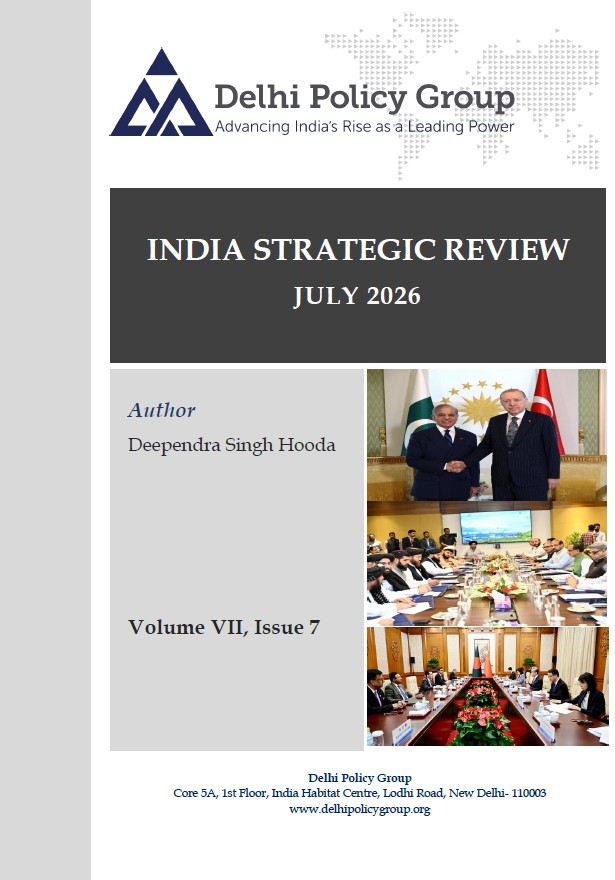
The ISR features an assessment of key developments, trends, and policies pertaining to India’s immediate and continental neighbourhood and is authored by Lt. Gen. Deependra Singh Hooda (Retd.), Distinguished Fellow for Military Strategy.
Pakistan’s mediation effort in the US-Iran war suffered a setback when President Donald Trump announced on July 8 that the interim ceasefire was over. The conflict has since widened, drawing in Saudi Arabia, Kuwait and Bahrain, with Yemen's Houthis also opening a new front in the Red Sea. Pakistan has expanded its military diplomacy through Kuwait’s ratification of a defence cooperation agreement as well as closer engagement with Türkiye and other Gulf states. These initiatives enhance Pakistan’s diplomatic relevance but could complicate its claim to act as a neutral intermediary with Iran.
Pakistan’s internal security situation remains grim. The first week of July saw one of the deadliest waves of attacks on the security forces in Balochistan, including the killing of 27 policemen at Ziarat. Islamabad responded with Operation Shaban in Balochistan, but militant violence continued through the month.
The protest movement in Pakistan-occupied Kashmir intensified and became intertwined with elections to the regional legislative assembly. Thirty people were reportedly killed during the first phase of polling on July 27. Pakistan’s coercive response has deepened political alienation and discredited its claim to champion Kashmiri rights.
Pakistan-Afghanistan tensions continue, with the United Nations mission in Afghanistan documenting 499 civilians killed and 1,216 wounded in cross-border fighting between October 2025 and the end of June 2026. The conflict has severely disrupted Afghanistan's transit trade through Pakistan, which fell by 93 per cent during the 2025-26 fiscal year. This has accelerated Kabul's efforts to reduce its dependence on Pakistan by expanding economic and diplomatic engagement with Iran, India, Central Asia, China, and Russia. India is now Afghanistan's largest export destination.
External Affairs Minister Dr. S. Jaishankar met Chinese Foreign Minister Wang Yi in Manila on July 22. The meeting was followed by an unusual public dispute after China's readout claimed India had affirmed its positions on Taiwan and Tibet, which the Ministry of External Affairs contested. The ongoing bilateral thaw nonetheless holds, with border trade resuming through Lipulekh and Nathu La from August 1 and Foreign Secretary Vikram Misri visiting Beijing on July 27-28.
In Bangladesh, President Mohammed Shahabuddin resigned on July 24, removing one of the last senior constitutional office holders associated with the former Awami League government. Former Prime Minister Sheikh Hasina has announced her intention to return to Bangladesh in December, where she faces immediate arrest and a death sentence.
Bangladesh and China advanced discussions on a proposed China-Myanmar-Bangladesh Economic Corridor. The project would link China’s Yunnan province with Bangladesh’s ports through Myanmar and extend Beijing’s connectivity presence towards the Bay of Bengal. However, the continuing civil war in Myanmar and the unresolved Rohingya issue make early implementation unlikely.
In Nepal, Prime Minister Balendra Shah completed his first 100 days with a mixed record. The government has moved quickly on digital governance, administrative simplification and anti-corruption measures, but an independent assessment has found that barely a third of its initial commitments had been delivered. Reliance on ordinances, limited parliamentary engagement and uncertainty over economic and foreign policy have raised questions over governance effectiveness.
Sri Lanka entered the final phase of its IMF programme with the disbursal of $695 million. Programme performance remains broadly satisfactory, but the recovery is fragile. Higher energy costs, falling tourism receipts, rising inflation and public debt close to 100 per cent of GDP remain significant concerns.
To read this issue please click India Strategic Review, Vol. VII, Issue 7.