


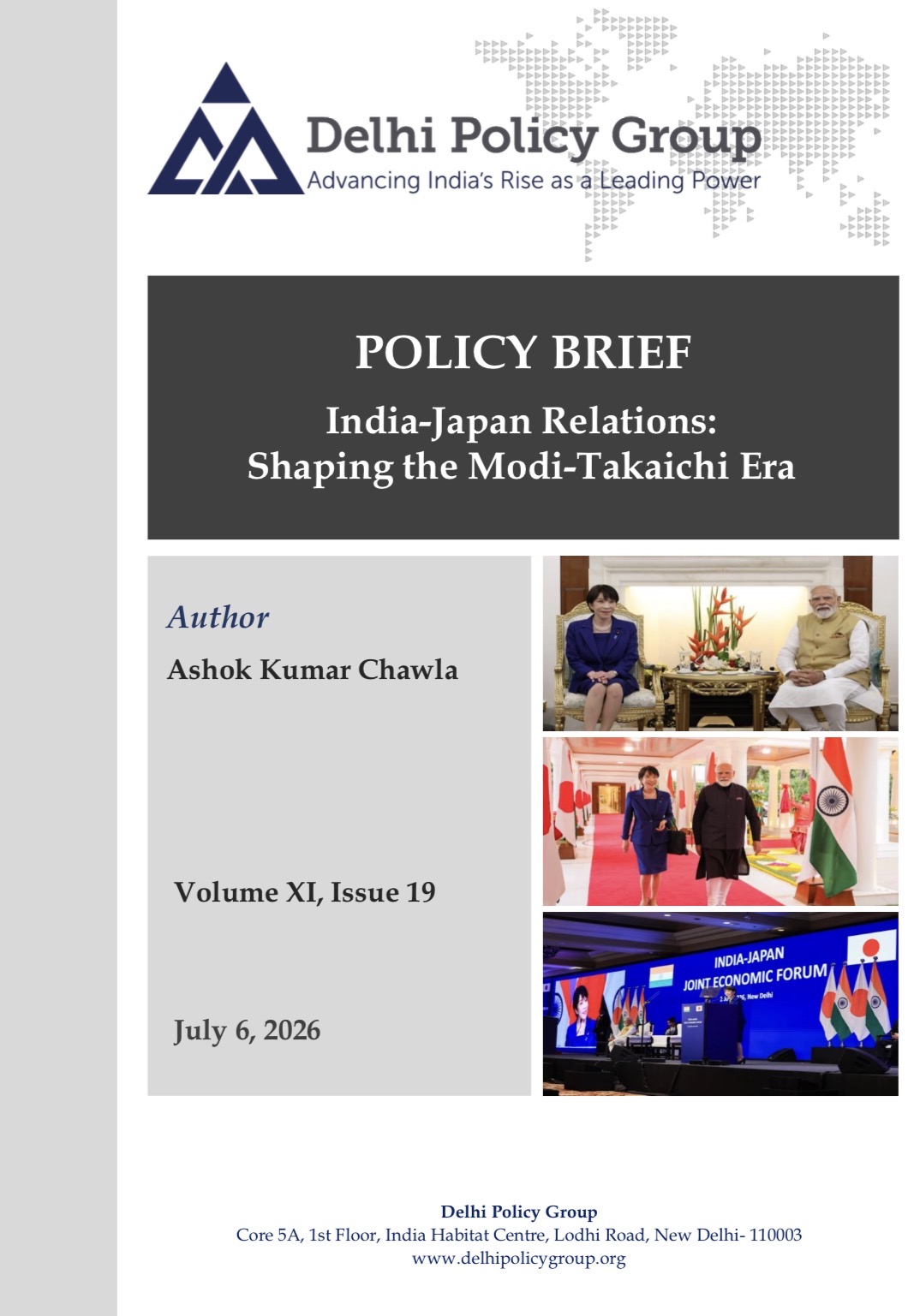
India-Japan Relations: Shaping the Modi-Takaichi Era
India and Japan have long been described as natural partners: two Asian democracies and major economies bound by shared values, civilisational goodwill, complementary strengths, and converging strategic interests. Yet, despite the considerable progress made over the past quarter century, the translation of that convergence into durable mechanisms, concrete projects, and ground-level execution has often seemed slower than the relationship's potential has warranted.
The 16th Bilateral Summit held in New Delhi on July 2, 2026 may come to mark another transformational moment in the substance and structure of India-Japan ties.
In this policy brief, Dr. Ashok Kumar Chawla - a longstanding observer and practitioner of the India-Japan relationship, having served as interpreter to Prime Ministers across multiple summits, as well as Japan Adviser in the Ministry of External Affairs - assesses the outcomes of this summit with analytical rigour, against the backdrop of his extensive institutional knowledge. He interrogates what was delivered, what remains conditional, what the relationship needs to sustain, and what it must deepen over the decade ahead.
Several themes outlined in this brief will be of particular interest to policymakers, business leaders, and strategic analysts alike. The formal alignment of Japan's updated Free and Open Indo-Pacific (FOIP) vision and India's MAHASAGAR - two frameworks that have emerged from different national traditions and strategic imperatives - as convergent expressions of the same strategic intent is a development of quiet but lasting significance. The confirmation of the first-ever India-Japan defence co-development project, UNICORN, read alongside Tokyo's historic revision of its defence export guidelines, opens a new chapter. The adoption of the first standalone India-Japan Joint Declaration on Economic Security - extending well beyond trade and supply chains into energy resilience, critical minerals, pharmaceuticals, and digital infrastructure - signals that both capitals now see economic security in its fullest and most strategic sense.
What this brief also underlines is that while intentions are clear and firmly in place, it is the implementation architecture, a skilled and sector-specific human capital pipeline, and sustained working-level commitment that will ultimately determine whether this summit's extensive outcomes endure and compound over time.
This brief is a timely and substantive contribution to informed public discourse on one of Asia's most important and consequential bilateral partnerships, one that will also contribute to the broader stability and prosperity of the Indo-Pacific.
To read this DPG Policy Brief Volume XI, Issue 19, please click “India-Japan Relations: Shaping the Modi-Takaichi Era”.