


Global Horizons
In this issue, the author opens with the assessment that as the interplay between complex strands of international security and economic dimensions deepens, the victors and beneficiaries of the post WW II order are circling the wagons around their power and privileges, pushing back against contemporary realities and the direction in which the world is headed. Their efforts to maintain dominance include seemingly innocuous and high sounding initiatives, but which in reality are only designed to further bend international institutions to their purpose.
At the same time, the ongoing wars today and those unleashed by major powers earlier demonstrate the ultimate unviability of the use of military force to achieve their objectives. Nonetheless, new forms of warfare, high-tech and outer space capabilities are being developed to maintain dominance. An arms race is underway, but one which also offers low cost alternatives to countries facing aggression.
Meanwhile, the interdependence created by decades of globalisation has led to the deployment of choke points against competitors as well as efforts to derisk supply chains. China, the US and the EU are in the forefront of this process, while countries like India and those of the Global South are facing the heat.
The High Level segment of the UNGA held during the month demonstrated the importance of the UN as the global Town Hall, enabling free debate on problems besetting the international community. Some 130 heads of government or senior leaders addressed the session, with its theme designed to reduce the gap between the the lofty principles of the UN Charter and their application in practice. However, the challenge to restore legitimacy and representative character to the UN system will not be an easy task.
Elsewhere during the month, President Trump moved to mend fences with Europe and NATO over Greenland. US pressures on Cuba mounted. The US-Canada trade dispute heated up, and the EU offered to welcome Canada as its first ever Associate Member.
The war in Ukraine continued to impose a deadly toll, amidst some signs of US re-engagement on a peace process, while Russia persisted on an unrelenting path.
As the standoff over Gaza continued and Israeli settlements in the occupied West Bank expanded, the UNGA session underlined widespread support for a two-state solution for Palestine.
The military stalemate in Iran continued, but the US blockade of Hormuz and economic sanctions increased coercive pressures on Iran. Meanwhile, the Houthi push towards the Bab-al-Mandeb strait added to challenges facing Saudi Arabia.
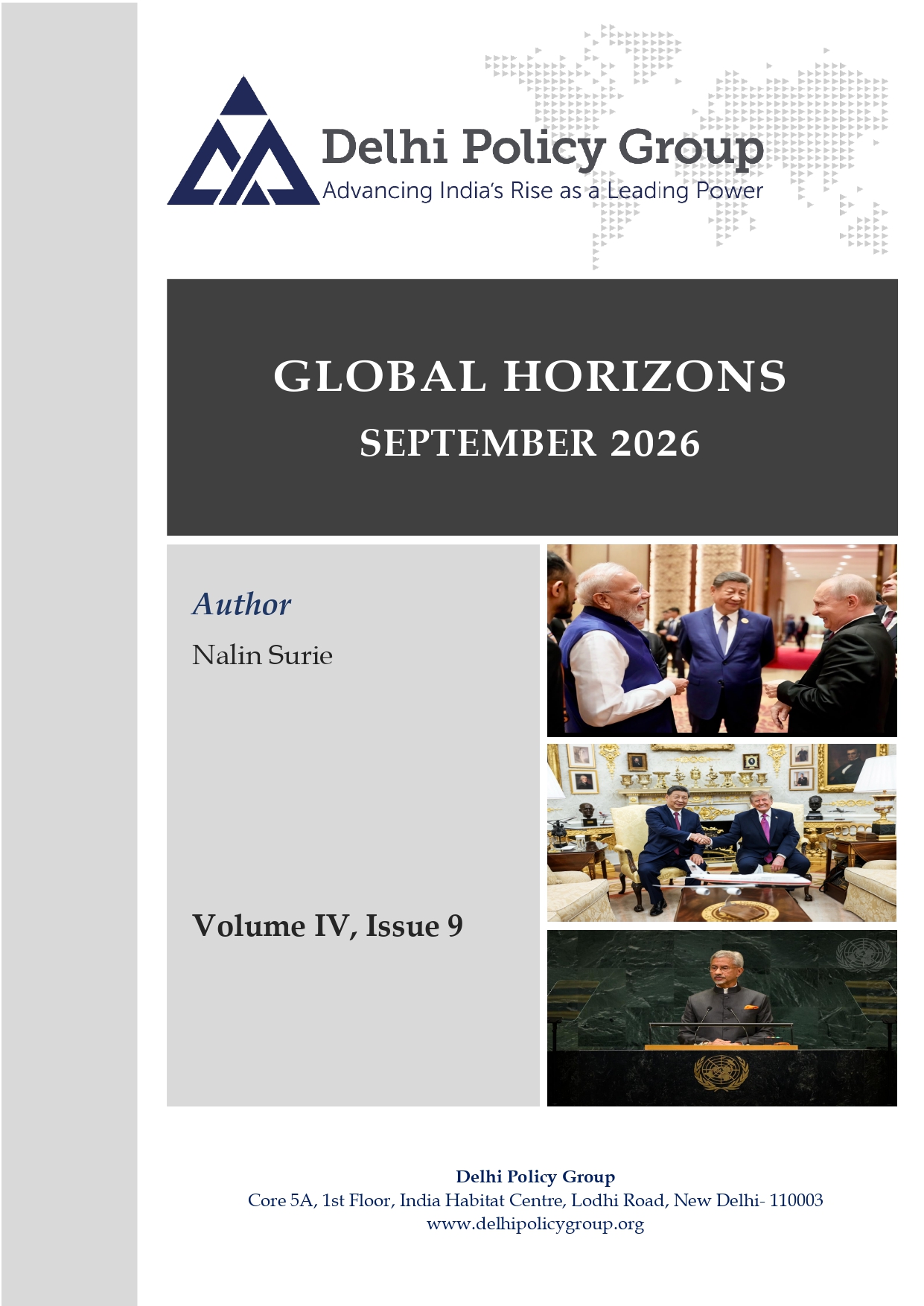
India successfully hosted the 18th BRICS summit in New Delhi on September 12-13, prioritising cooperation for the development of the Global South and seeking to address inequities in the systems of international governance, without being anti-West. A wide ranging summit Declaration was adopted by consensus, but it reamains to be seen how the concrete outcomes announced by India will be taken forward by China as the next Chair. A meeting between PM Modi and President Xi saw further progress on stabilising bilateral relations.
President Xi paid a state visit to the US marked by pomp and pageantry, with rather modest pre-negotiated outcomes centred around a ‘constructive relationship of strategic stability’ on the basis of ‘respect, fairness and reciprocity’. The US-China trade truce was extended till January, while Xi and Trump agreed to meet again at the APEC and G20 summits later this year.
In his UNGA address, EAM Dr. S. Jaishankar warned that while we are well on the way towards a multipolar world, the process of accommodation and acceptance of that reality will not be easy.
To read this issue please click Global Horizons, Vol. IV, Issue 9.