


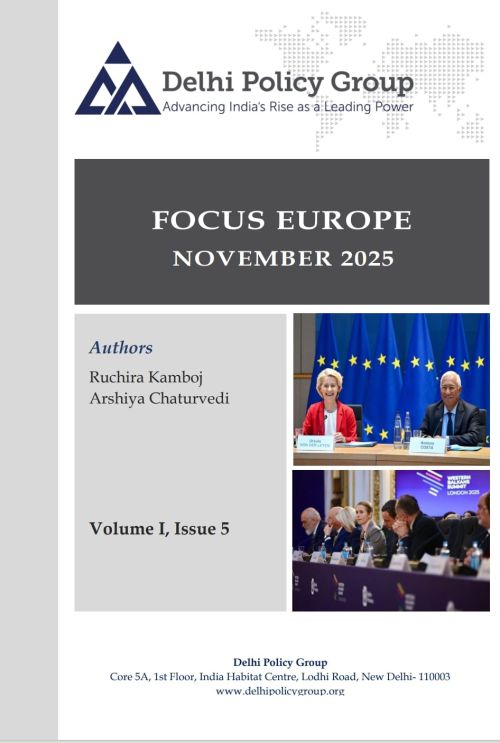
Focus Europe
The ‘Focus Europe’ monthly features studies of strategic developments and security issues in Europe, the progress of EU-India relations, and India’s ties with major European powers.
This month, the authors take a closer look at the prospects of enlargement of the European Union. High Representative Kaja Kallas’s remarks on November 4, 2025 have brought renewed clarity to the EU’s enlargement agenda, as she has presented a scorecard of nine countries which are at different stages of accession. She has noted that “chances to enlarge the Union do not come often, but the window is now wide open,” describing the accession of new members by 2030 as a “realistic goal.” With this, enlargement issues are likely to remain in the the forefront of the European debate.
It is important to recall that the current enlargement agenda is not solely driven by the Russia–Ukraine conflict. While Ukraine, Moldova and Georgia applied for membership in 2022 amid the war, the remaining candidates have had their applications on the table for years, and in some cases, for decades. The present focus builds on long-standing aspirations that are now converging with a new geopolitical conjuncture.
The authors point out that this phase of eastward expansion is not simply a political exercise in extending the EU’s borders. It reflects a strategic recalibration of the Union as it responds to Russian aggression, instability in its neighbourhood, and shifts in global power. As Kallas has stressed, enlargement is no longer “a nice to have but a necessity” if Europe is to remain a stronger and more influential actor on the world stage.
EU membership requires adherence to the Copenhagen political and economic criteria, full adoption of the EU’s legal framework, and unanimous approval from all existing member states. Regardless of geography or borders, each candidate must demonstrate stable democratic institutions, a functioning market economy, and the capacity to implement the acquis. The process, as Kallas noted, is intended to remain ‘tough, fair and merit-based.’
Despite the renewed political will, EU enlargement remains a demanding and complex undertaking. The process is shaped by challenging accession negotiations, institutional constraints within the EU, and evolving geopolitical realities. Progress depends not only on reforms within candidate states but also on consensus among EU members, a hurdle that has slowed previous rounds of expansion.
This moment presents an essential paradox. The EU’s drive to strengthen its geopolitical influence coincides with its commitment to a stringent, rules-based accession framework. Balancing strategic necessity with principled conditionality will define this enlargement round, and determine whether the Union can expand without compromising the integrity of its own standards.
To read this Focus Europe, Vol. I, Issue 5, please see the PDF attached.