


Economic Security and Resilience Review
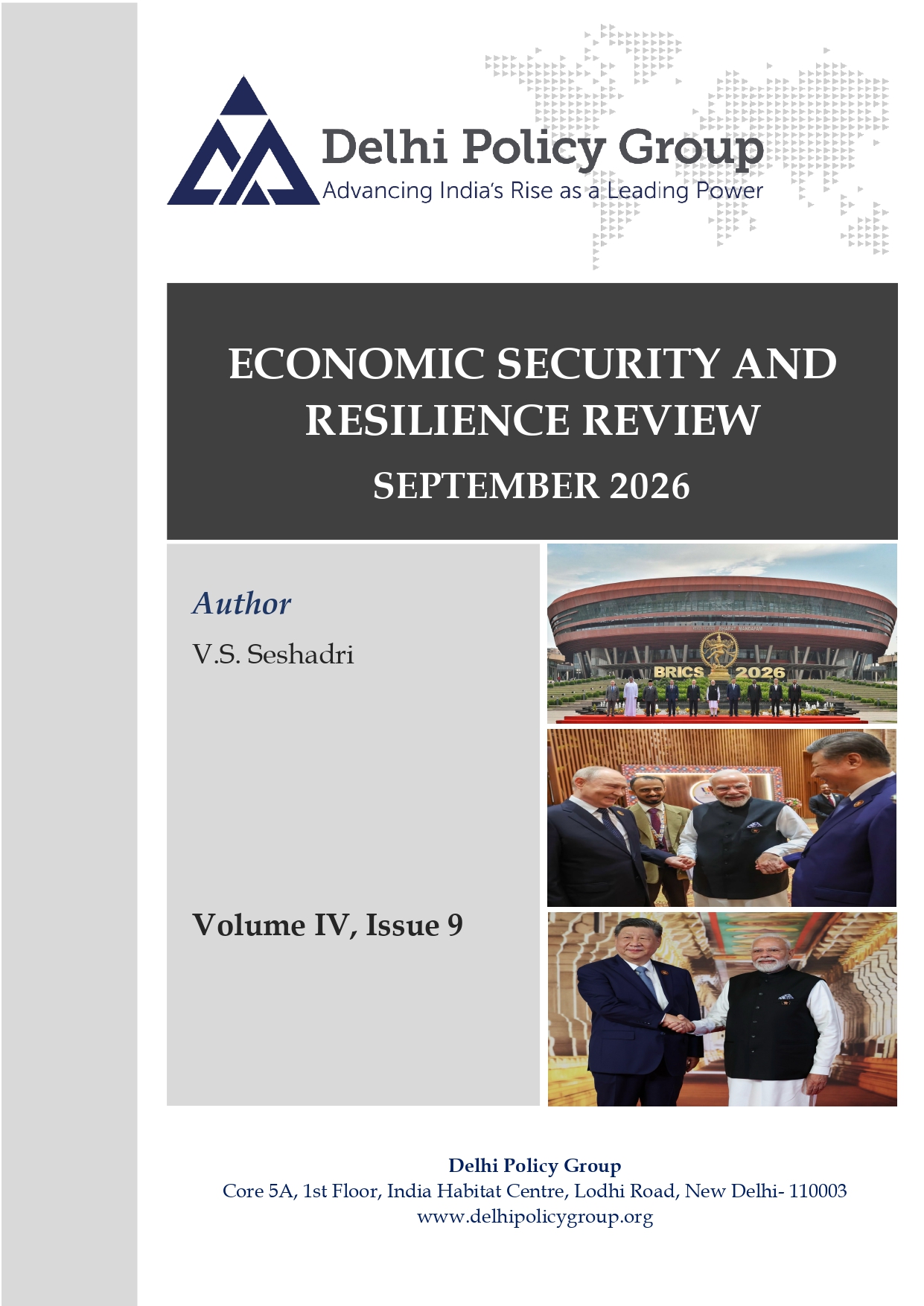
This issue of ESRR captures the key outcomes from the 18th BRICS Summit, successfully hosted by India that also marked the 20th anniversary of the organisation. The New Delhi Declaration reaffirmed support for WTO reform, including restoration of a fully functioning dispute-settlement mechanism, while defending MFN and Special and Differential Treatment. It also expressed concern over unilateral tariffs, sanctions and other coercive economic measures, and called for reliable and diversified critical-mineral supply chains. Trade settlement in local currencies among the members is seeing some moves. Significantly, however, there was no endorsement of a common BRICS currency or an overt challenge to the US dollar. India also proposed developing a BRICS Reform Roadmap for global governance.
The Summit provided an opportunity for India to engage its major strategic partners. Discussions with China highlighted the need to address the structural trade imbalance, supply-chain concerns and market-access issues, although no specific economic initiative emerged. Engagements with Russia and Iran also underscored India’s continuing interest in energy security, connectivity and the protection of maritime trade amid geopolitical tensions.
The most immediate economic-security concern arose from the US Sanctioning Russia and Iran Act (SRIA), signed into law on September 18. It provides for potentially substantial additional tariffs on major purchasers of Russian oil, although the President has waiver powers in the national interest. India has conveyed its concerns at senior levels, stressing the importance of energy security and diversified sourcing.
The Trump-Xi summit produced only a limited easing of US-China tensions. Their trade truce was extended by just two months, while China’s restrictions on critical minerals and rare earths remain an important source of uncertainty. This short extension suggests that supply-chain vulnerabilities will remain central to the bilateral relationship and to wider economic-security calculations.
For India, the US State Department’s Investment Climate Statement for 2026 simultaneously recognised significant improvements while highlighting regulatory uncertainty, enforcement practices, import controls and other barriers faced by foreign investors. These concerns underline the importance of improving regulatory predictability alongside industrial-policy objectives. At the same time the wish list in some areas identified by US businesses may have to be balanced with domestic interests.
Finally, the EU’s invitation to Canada to explore an unprecedented closer relationship points to the emergence of new forms of cooperation among like-minded middle powers, while China’s tighter exit-entry controls for technology experts highlight the growing intersection of human mobility, technology and national security.
To read this issue please click ESRR, Vol. IV, Issue 9.