


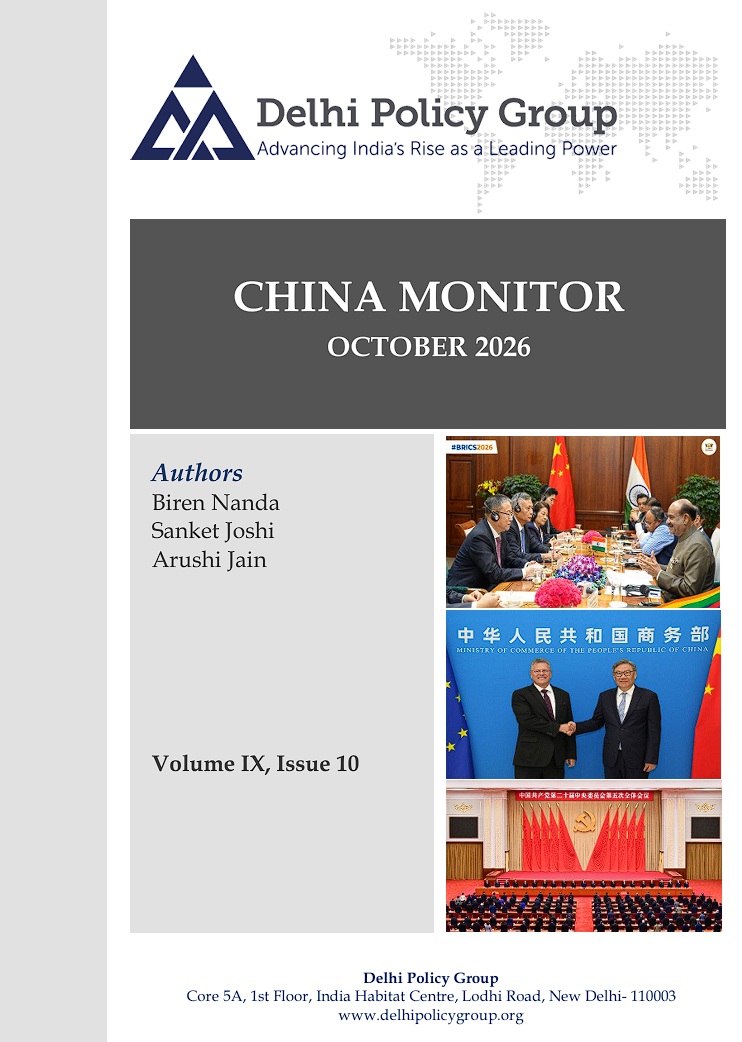
China Monitor
The monitor features developments related to China during the month and is compiled by our research team of Amb. Biren Nanda, Senior Fellow, Sanket Joshi and Arushi Jain, Research Associates, from open-source reports and publications.
On October 2, 2026, the Government of India identified 28 places/features located in India’s Union Territory (UT) of Ladakh by standard place and feature names on the official map of the Survey of India. Reacting to this, on October 13, 2026, China affirmed that it “does not recognise the so-called Union Territory of Ladakh unilaterally and illegally established by India”. Beijing also claimed that India’s move to publicise standardised names is “illegal and void”, and it “does not change the fact that the Western sector of the China-India boundary belongs to China”. India on its part rejected China’s territorial claims, asserting that the UT of Ladakh is an “integral and inalienable part of India” and no amount of denial by the Chinese side can change this established fact.
In response to a statement on October 22, 2026, by the Director General of Indo-Tibetan Border Police (ITBP) about “ongoing” face-offs with the Chinese PLA troops at various locations in Arunachal Pradesh, India’s Ministry of External Affairs clarified that “the situation in border areas between India and China sometimes gets disturbed when the PLA deviates from previously agreed patrolling practices”. China claimed that it strictly abides by relevant agreements and common understandings reached between Beijing and New Delhi and that the PLA conducts normal border patrols to safeguard the country’s territorial sovereignty.
On October 22, 2026, the U.S. Department of the Treasury issued a notice proposing expansion of restrictions on outbound American investments into dual-use strategic technologies in countries of concern such as China. Reacting sharply, China described Washington’s move as “discriminatory” and expressed concerns that the U.S.’ outbound investment curbs “run counter to the consensus reached by the leaders of the two countries” to build a relationship of constructive strategic stability.
On October 8-9, 2026, Chinese Commerce Minister Wang Wentao and the EU’s Trade Commissioner Maroš Šefčovič held the second meeting of EU-China Trade and Investment Consultations (TIC) in Beijing. The two sides reached consensus on a list of deliverables and undertakings, including balancing trade and investment, pursuing export-control dialogue, resolving intellectual property-related concerns, and strengthening cooperation on WTO reforms. Trade Commissioner Šefčovič announced that China has agreed to halve the exports of Hybrid Electric Vehicles (HEVs) and Plug-in Hybrid Electric Vehicles (PHEVs) to the European market.
The 20th CPC Central Committee held its fifth plenary session in Beijing from October 26-29, 2026. The CPC adopted a resolution calling for “Persevering with Full and Rigorous Party Self-Governance” based on “Xi Jinping’s Thought on Party Building”, which emphasises discipline, political loyalty, and sustained action against corruption.
To read this issue please click China Monitor, Vol. IX, Issue 10.
