


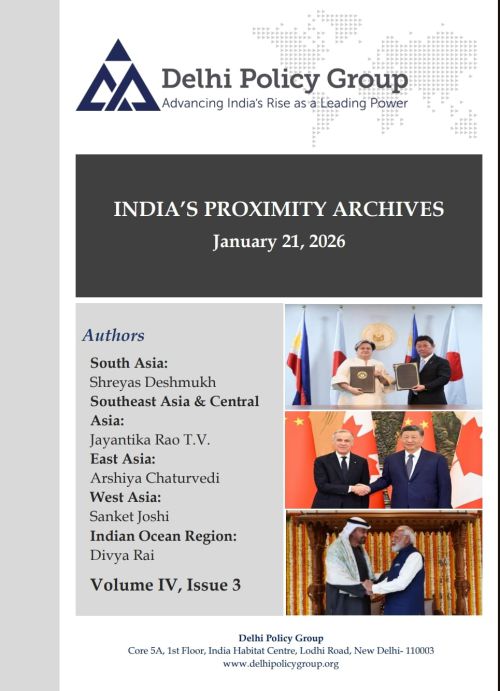
India’s Proximity Archives
South Asia
Prominent leaders of major political parties of Nepal, including KP Sharma Oli and Pushpa Kamal Dahal ‘Prachanda’, have filed their nominations for the upcoming elections set to take place on March 5. Former Kathmandu Mayor Balendra Shah, a leader of the Rastriya Swatantra Party, submitted his candidacy on January 20. Having resigned from his mayoral position to run in the general elections, he announced that he will compete against the former prime minister KP Sharma Oli in the same constituency. Nepal’s Election Commission implemented the Election Code of Conduct, starting on January 19. Meanwhile, India provided Nepal with its first batch of election-related assistance on January 19.
Southeast Asia
On January 15, Japan and the Philippines signed a pact that would allow the tax-free provision of ammunition, fuel, food and other necessities when their forces stage joint training to boost deterrence against China’s growing aggression in the region and to bolster their preparation for natural disasters. The Acquisition and Cross-Servicing Agreement (ACSA), signed by Philippine Foreign Secretary Theresa Lazaro and Japanese Foreign Minister Motegi Toshimitsu in Manila, comes against a backdrop of persistent tension in maritime Asia, particularly in the South China Sea and the Taiwan Strait. During the ceremony, Japan also announced 2.53 billion yen (US$ 15.9 million) of new security and economic development assistance to the Philippines. This included US $6 million in Official Security Assistance to fund the building of facilities to house rigid hulled inflatable boats previously donated by Japan, and funds to expand internet access in parts of the Southern Philippines affected by the region’s separatist conflict.
East Asia
On January 16, Canadian Prime Minister Mark Carney, on his official visit to China, met Chinese President Xi Jinping in Beijing. President Xi noted that China–Canada relations have followed a positive development trajectory since the two leaders last met in Gyeongju, Republic of Korea, in October 2025. This has resulted in the resumption of cooperation across various fields and the achievement of many positive outcomes. Further emphasising that this positive momentum should be sustained with the two countries advancing their bilateral relations into a Strategic Partnership, Xi proposed four points to achieve this objective. These are mutual respect for sovereignty, integrity and choice of political path; shared development by expanding cooperation and reducing areas of discord; building trust through enhanced people-to-people exchanges; and close collaboration on multilateral platforms such as the UN, G20, and APEC to address various global challenges. Concurring with the four points proposed by Xi and reaffirming Canada’s commitment to the One-China policy, the Canadian Prime Minister expressed his government’s intention to advance bilateral ties into a Strategic Partnership.
West Asia
UAE’s President Sheikh Mohamed bin Zayed Al Nahyan paid an official visit to India and held a meeting with Prime Minister Narendra Modi on January 19. The two sides signed a joint statement pledging to double bilateral trade to USD 200 billion by 2032, a 10-year LNG deal, and a letter of intent to conclude the Strategic Defence Partnership. Major issues discussed in the meeting included India-Middle East-Europe Economic Corridor (IMEC), the UAE’s support for India’s BRICS chairmanship in 2026, a zero-tolerance approach towards terrorism, and cooperation in the food security and space sectors.
Central Asia
On January 19, the first cross-Caspian Sea China-Central Asia freight train departed from north China’s Tianjin Municipality to Baku, Azerbaijan, carrying goods such as stainless-steel pipes and household appliances. The train, operated by China Railway Beijing Group, will leave the country via Horgos Port in northwest China's Xinjiang Uygur Autonomous Region before traversing Kazakhstan and ultimately being shipped across the Caspian Sea to Baku. Spanning a journey of approximately 7,000 kilometres in about 20 days, the route cuts travel time by around 10 days compared to traditional sea transport.
Indian Ocean Region
The ICC International Maritime Bureau (IMB) reported an increase in global maritime incidents and piracy and armed robbery in 2025, classifying most cases as low-level. According to the IMB Annual Piracy and Armed Robbery Report, 137 incidents against ships were recorded in 2025 compared to 116 in 2024 and 120 in 2023. It reveals that 121 vessels were boarded, four vessels were hijacked and two were fired upon, as well as 10 attempted attacks. While most reported incidents in 2025 were categorised as low level, violence against crew continues, with 46 crew members taken hostage in 2025 compared to 126 in 2024 and 73 in 2023. Twenty-five crew were reported kidnapped, compared to 12 in 2024 and 14 in 2023. A further 10 crew were threatened, four injured and three assaulted in 2025. Additionally, the report highlights that the greatest number of incidents are with vessels that are underway (88 of the reported boardings in 2025). A vessel that was steaming was three times more likely (27) to be boarded than a ship at anchor. Also, bulkers remain the most vulnerable type (50), with containerships and product tankers each at approximately 20 incidents. Geographically, Southeast Asia is the area of greatest concern, accounting for 95 of the incidents reported last year. While there was also a highly publicised re-emergence of incidents off Somalia, IMB highlights that the lack of a broader resurgence was due to the continuing deterrents of the naval presence in the region and vessels being on alert and hardening their defences. Two of the incidents it notes were far from shore, showing that Somali pirate groups can still interfere with shipping.
To read this issue, please click India’s Proximity Archives, Vol. IV, Issue 3.