


India's Proximity Archives
South Asia
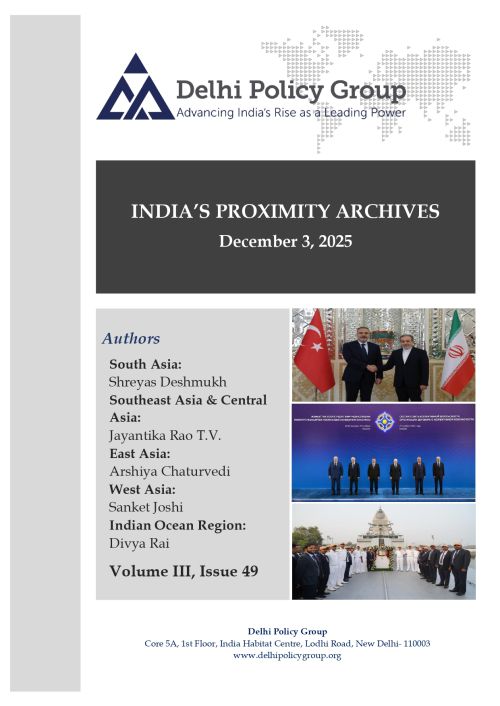
On November 30, an unannounced discussion was held in Riyadh between a high-level delegation from the Islamic Emirate of Afghanistan and Pakistan, mediated by Saudi Arabia. This visit follows three rounds of discussions between the Afghan and Pakistani delegations, which took place in Doha and Istanbul under the mediation of Turkey and Qatar. No official declarations have been issued by Afghan, Pakistani, or Saudi authorities regarding the visit or the specifics of the consultations. Turkish Foreign Minister Hakan Fidan, anticipated to head a delegation to Islamabad to assist in mitigating tensions between Afghanistan and Pakistan, made a visit to Tehran on November 30. A regional summit will be held in December, according to Iran’s foreign minister, to resolve the current issues between Afghanistan and Pakistan. In the meantime, the Security Council may contemplate a resolution on this conflict, as suggested by a UN report.
Southeast Asia
On December 1, the Philippines announced it would defer awarding part of a US$ 3.9 billion plan to build a 32 km bridge across Manila Bay after opposition to the potential involvement of Chinese firms, citing national security concerns. Currently, the Asian Development Bank (ADB) is reviewing proposals to ensure compliance with environmental and governance standards. The China Harbour Engineering Company submitted the most competitive bids of 4.87 billion peso (US$81.7 million) offer for the 7.25 billion peso (US$124 million) land approach project. However, the Public Works Secretary Vince Dizon, Defence Secretary Gilberto Teodoro Jnr, the Philippine Interisland Shipping Association and other maritime industry stakeholders urged rejection of the bid, warning that awarding the project to a Chinese state-owned firm posed risks of sabotage, intelligence gathering, and integrity issues. China Harbour, a subsidiary of China Communications Construction Company, has faced scrutiny with it being sanctioned by the US in 2020 for destructive dredging in the South China Sea and alleged corruption, predatory financing, and environmental abuses.
East Asia
At the event celebrating the 80th anniversary of the North Korean Air Force on November 30, Kim Jong Un, the North Korean leader, proclaimed that the country’s air force will be upgraded with "new strategic military assets”. Kim also emphasised the national air force’s potential role in establishing nuclear deterrence and in countering espionage activities or potential military provocations by adversaries. Visual accounts from the event show the North Korean leader observing the unmanned aircraft, the First Person View (FPV) drone, mobile missile launchers and other things. North Korea is already undertaking mass production of the displayed short-range FPV drone.
West Asia
On December 2, Israel’s Prime Minister Benjamin Netanyahu met with the US President’s Envoy for Lebanon, Morgan Ortagus, as border tensions with Lebanon’s Hezbollah mounted. Israel cautioned that the Lebanese government is not taking sufficient steps to disarm Hezbollah, which has grown its ranks and replenished missiles and rockets smuggled from Syria. The IDF warned that unless Hezbollah disarms, another round of conflict is inevitable. Meanwhile, on December 2, the UN General Assembly approved a resolution calling on Israel to withdraw from the Golan Heights. Israel rejected the UNGA resolution, asserting that it demonstrated the UN’s "detachment from reality". Rather than addressing the crimes perpetrated by the Iranian axis or the dangerous activities of militias in Syria, the resolution calls for Israel to withdraw from the Golan Heights, a strategic defence line crucial for protecting Israeli citizens.
Central Asia
On November 27, the summit of the Collective Security Treaty Organization (CSTO) was held in Bishkek. In order to strengthen the analytical capacity of the Organisation, the Collective Security Council decided to establish an Information and Analytical Department within the CSTO Secretariat. The new unit is tasked with comprehensively monitoring and forecasting the situation in the CSTO area of responsibility. One of the outcomes of the session was the adoption of the CSTO Collective Security Council Declaration. The meeting participants also reviewed interaction within the CSTO in 2025 and coordinated plans to improve the system of collective security. As the upcoming chair, Russian President Vladimir Putin briefed the meeting on the priorities of Russia’s CSTO chairmanship in 2026 and unveiled the theme as “Collective Security in a Multipolar World”. Armenia chose to boycott the meeting once again.
Indian Ocean Region
INS Taragiri, the fourth Nilgiri-class frigate under Project 17A and third built by Mazagon Dock Shipbuilding Ltd (MDL), was delivered to the Indian Navy on 28 November 2025 at MDL, Mumbai. Taragiri revives the name of a former Leander-class frigate that served from 16 May 1980 to 27 June 2013, offering 33 years of service, while introducing leaps in stealth, firepower, automation, and survivability. Designed by the Warship Design Bureau and overseen by the Warship Overseeing Team (Mumbai), it follows integrated construction for timely delivery and features 75% indigenisation, involving over 200 MSMEs. The weapon suite includes BrahMos supersonic missiles, MF-STAR radar, MRSAM air defence, 76 mm super rapid gun, 30 mm and 12.7 mm close-in weapons, and ASW rockets/torpedoes. It is the fourth P17A delivery in 11 months, with three more (one from MDL and two from GRSE) due by August 2026.