


Economic Security and Resilience Review
There is a sense of satisfaction in the Indian Government about its management of the economic fallout from the West Asian conflict. A combination of supply and demand side interventions, together with timely macroeconomic policy adjustments, have helped India mitigate potential disruptions. This issue of ESRR looks at these measures, which have been highlighted in a recent article by Chief Economic Adviser Anantha Nageswaran. The Reserve Bank of India's latest Financial Stability Report also assesses that the interim US-Iran peace agreement has shifted the balance of risks in a more favourable direction, supported also by recent policy measures taken by the Government and the Reserve Bank aimed at strengthening capital inflows.
Drawing lessons from the crisis, the government is reportedly moving ahead with plans to substantially expand India's Strategic Petroleum Reserve (SPR) capacity from the current level of around 5.33 MMT - equivalent to approximately 9.5 days of consumption - to about 24 MMT, covering nearly 40 days of consumption. This would complement the inventories maintained by refineries and oil marketing companies, which typically provide an additional 60 days of demand cover.
Despite visits to India by two delegations from the Office of the United States Trade Representative (USTR), including one led by USTR Jamieson Greer, uncertainty persists regarding the outstanding issues in the proposed interim bilateral trade agreement under negotiation since March 2025, for which a framework was announced earlier this year. There is also limited clarity on how the two ongoing US Section 301 investigations - relating to forced labour practices and excess industrial capacity - may influence the final tariff treatment accorded to India. Following these engagements, Commerce Minister Piyush Goyal has reiterated that India would not conclude a trade agreement unless the United States is able to provide India with a clear and legally sustainable comparative advantage over competing economies.
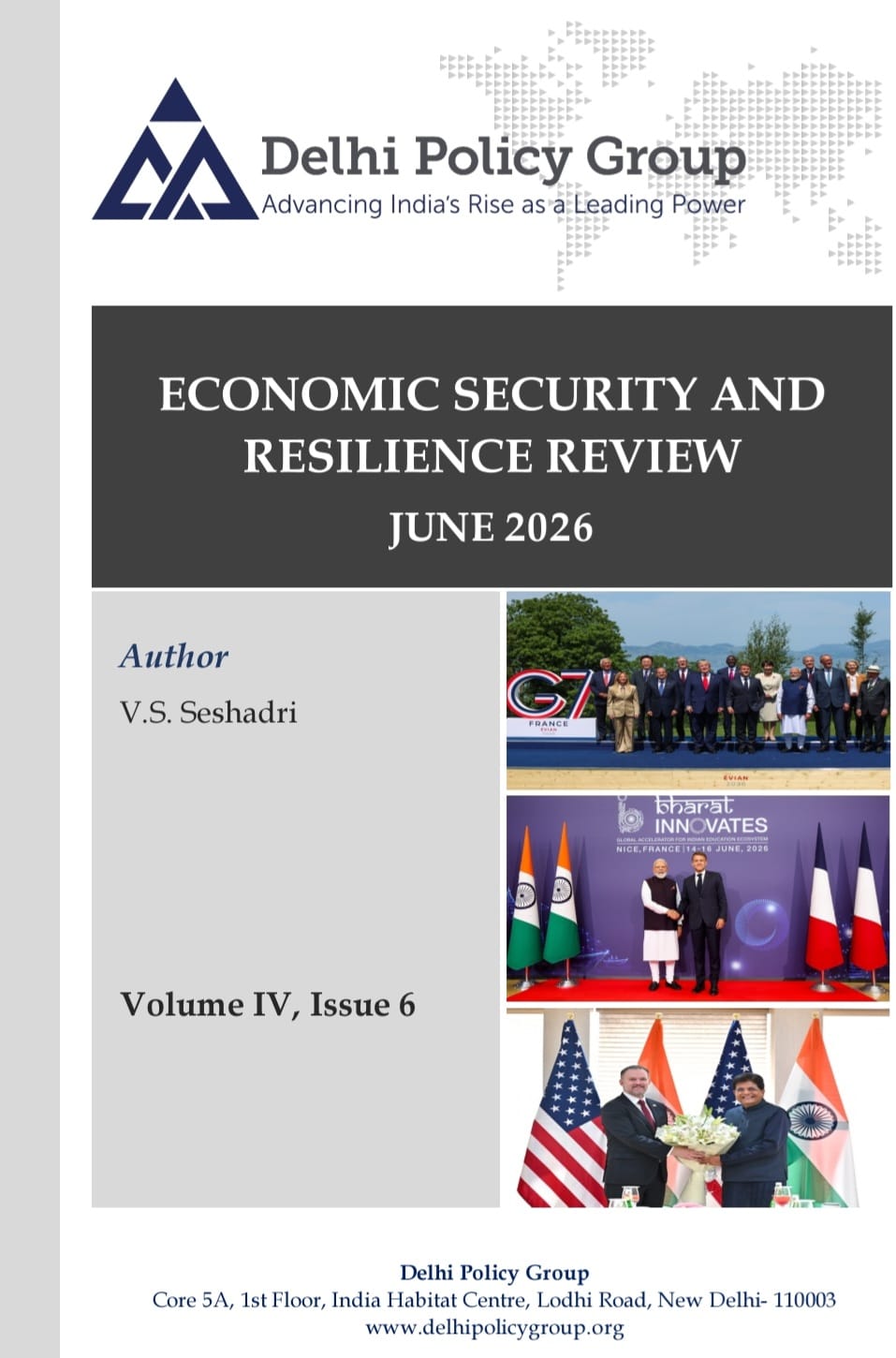
This issue also reviews Prime Minister Narendra Modi’s visit to France, his participation in the G7 Summit outreach meetings, and his bilateral engagements with several global leaders, including US President Donald Trump. Particular attention is devoted to the outcomes of the G7 Summit, especially the Joint Declaration on Critical Minerals, which marks a significant evolution in the G7's approach to critical mineral security, and the Joint Statement on Global Imbalances, which was substantially informed by the recommendations of the high-level expert group commissioned by the French G7 Presidency.
Expectations that the European Council would adopt a more robust trade strategy towards China have not been realised. Differences among member states, particularly Germany and Spain, resulted in the issue being deferred, with the European Commission tasked to undertake further consultations with key partners before additional measures are considered.
Developments in India's neighbourhood also merit close attention. Visits to China by Myanmar's President Min Aung Hlaing and Bangladesh's Prime Minister Tarique Rahman resulted in outcomes that could enable China to further expand Belt and Road Initiative (BRI) connectivity corridors, while also increasing its involvement in port infrastructure and industrial zone development. Given the proximity of these projects to India's land borders, these developments will require continued monitoring from an economic security perspective.
China has also brought into force new regulations implementing its Mineral Resources Law. The regulations comprehensively cover mining rights, exploration, extraction, stockpiling, environmental restoration, regulatory oversight and legal liability. Significantly, they provide the Chinese government with an explicit legal basis to adopt countermeasures against foreign governments that restrict China's access to external mineral supply chains.
In East Asia, both Japan and the Republic of Korea have announced multi-year public and private investment plans in strategic sectors. Semiconductors, artificial intelligence and data centres feature prominently in both countries' priorities, while Japan's programme spans as many as 17 designated strategic sectors.
Finally, this issue captures the key themes of External Affairs Minister Dr. S. Jaishankar's keynote address at the Jeju Forum for Peace and Prosperity on 25 June 2026, delivered under the theme, "Reinventing Cooperation in a Fragmented World," highlighting India's approach to navigating an increasingly complex geopolitical and geoeconomic landscape.
To read this issue please click ESRR, Vol. IV, Issue 6.